It’s annoying when a bedroom looks fine but still feels off. You lie down, and something just doesn’t sit right. The space feels tighter than it should. Or oddly exposed. Sometimes even sleep feels lighter than it should, like your brain never fully clocks out.
A lot of the time, it’s not the furniture or the color palette. It’s the bed position. People tend to push the bed wherever it fits, not where it works. And that small decision quietly shapes everything else in the room.

Why bed placement messes with the whole room
The bed is the visual anchor of a bedroom. It’s the biggest object and the one you interact with the most. So when it’s placed poorly, the entire layout feels slightly wrong.
Common issues usually look like this:
- The bed is squeezed against a wall with no breathing space
- It sits directly in line with the door, so it feels exposed
- One side is hard to access, which makes the room feel unbalanced
- It blocks natural light or awkwardly interrupts walking paths
Sleep experts also point out that environmental cues matter for rest quality. Light, noise direction, and even perceived safety can affect how deeply you sleep. The National Sleep Foundation highlights that the bedroom environment plays a real role in sleep consistency and quality.
So yes, bed placement isn’t just design talk. It changes how your body reads the space.
Start with the door, not the bed
Most people start by asking, “Where does the bed fit?” That’s backwards.
Start with the door instead. When you enter the room, your body wants a sense of control and visibility. If your bed is directly in line with the doorway, it can feel exposed. If it’s hidden too much, the room can feel disconnected.
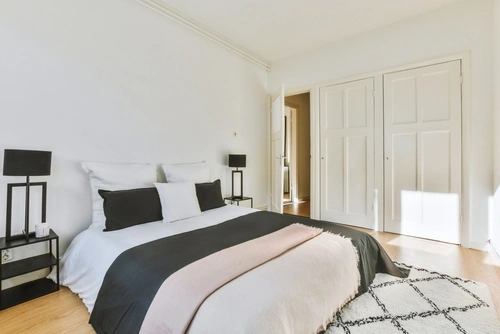
A better setup is usually:
- Bed placed diagonally or offset from the door
- Clear sightline to the entrance without being directly in it
- Enough walking space so you don’t shuffle sideways around furniture
Interior design sources like Architectural Digest often emphasize that circulation flow is just as important as furniture choice in small bedrooms.

Give the bed a “solid” wall
There’s a reason people instinctively push beds against walls. The brain likes stability behind it.
Ideally:
- Place the headboard against a solid wall
- Avoid windows behind the bed if possible (light and drafts can be distracting)
- Keep both sides accessible if the room allows it
Even feng shui principles talk about this idea of “command position,” where the bed faces the door but isn’t directly aligned with it. While not scientific, the underlying logic overlaps with comfort psychology—feeling secure in your resting space.
Watch what’s happening above the bed
People forget to look up.
Heavy shelves, awkward beams, or low-hanging decor can quietly make a room feel tense. Even if nothing is physically wrong, your brain registers pressure overhead.
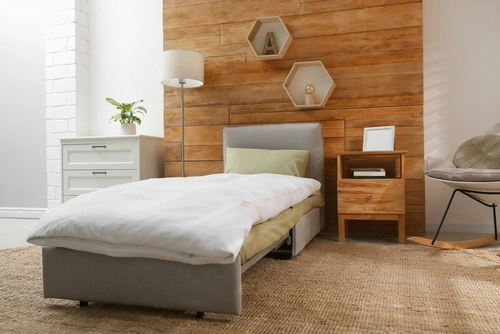
If something feels “off” in your bedroom:
- Remove heavy storage above the bed
- Keep wall decor simple and centered
- Avoid cluttered arrangements that visually crowd the headboard
It’s not about minimalism for style points. It’s about reducing visual noise where your brain tries to wind down.
Balance both sides (even if the room is small)
Asymmetry is one of those things people don’t notice consciously, but feel constantly.
If one side of the bed has a nightstand and the other is squeezed against a wall, the space starts to feel uneven. That can subtly affect comfort, especially in shared bedrooms.
If space is tight:
- Use floating shelves instead of bulky nightstands
- Keep lighting balanced on both sides if possible
- Try to avoid pushing one sleeper into a “corner position” unless necessary
Small changes here often make a room feel twice as functional without adding anything new.
Think in walking paths, not furniture pieces
A bedroom isn’t just a place where things sit. It’s a space you move through.
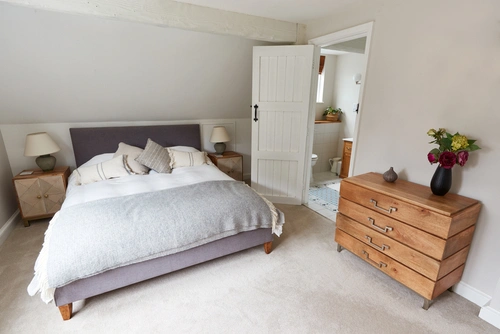
If you find yourself:
- Sidestepping around the bed
- Turning awkwardly near the drawers
- Or squeezing past furniture in the dark
That’s usually a layout problem, not a size problem.
Good layouts keep movement simple. You should be able to walk from the door to the bed to the wardrobe without thinking too much about it.
Conclusion
Most bedroom discomfort doesn’t come from obvious mistakes. It comes from small placement decisions that accumulate. The bed is usually the center of it all, even when no one thinks about it that way.
When the bed sits in a better position, the whole room changes. Movement feels easier. Rest feels more settled. Even the room looks more intentional without adding anything new.
It’s less about rules and more about noticing what already feels slightly wrong and adjusting from there.
If something feels off in your bedroom, start by moving the bed a little. Not redecorating. Not buying anything. Just shifting it and seeing how the room reacts.